
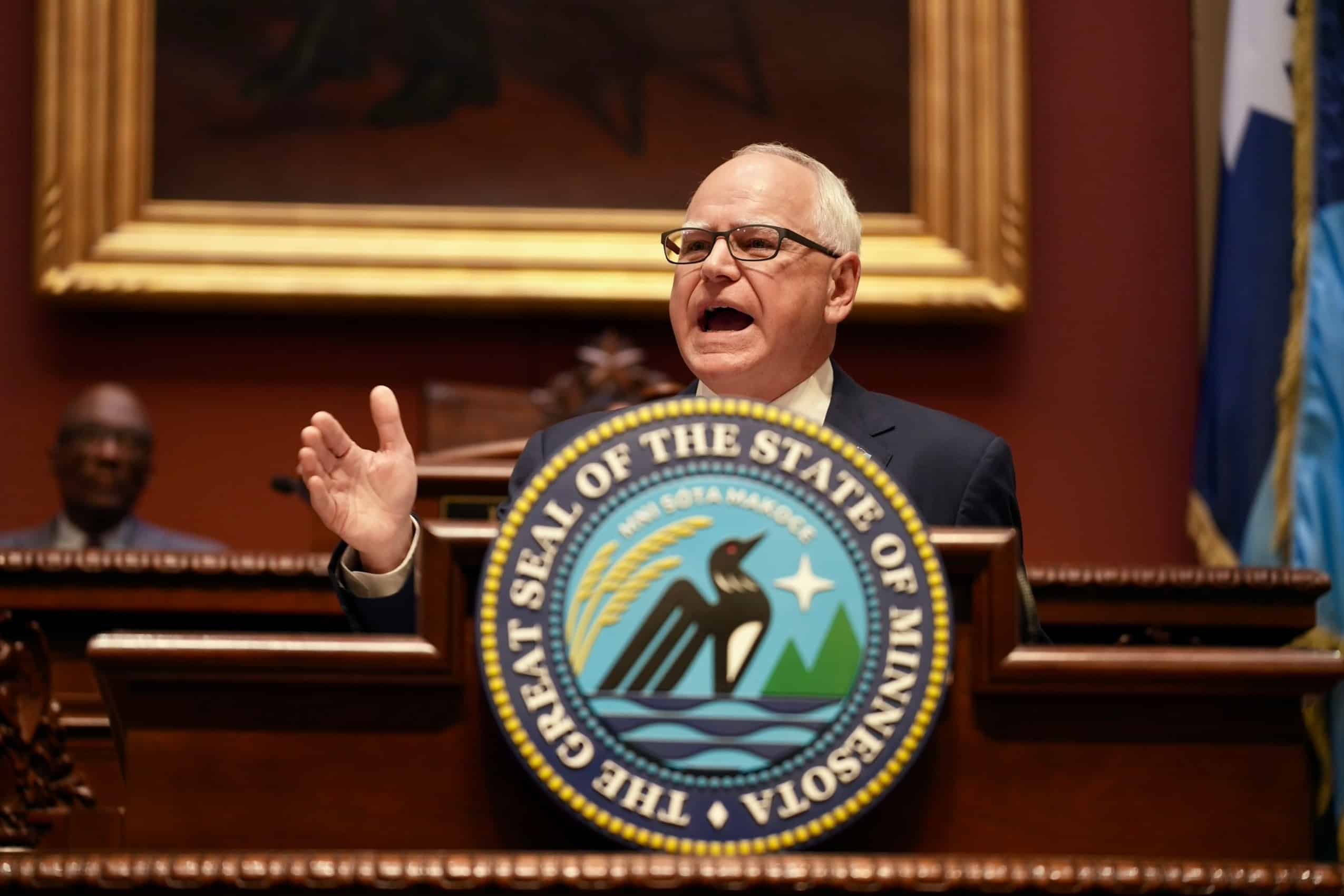
As states throughout the country respond to Virginia’s now-failed gerrymandering effort, Minnesota Gov. Tim Walz appears to be suggesting that his successor could gerrymander Minnesota’s congressional seats.
On Thursday, Walz commented on a Washington Post op-ed which argued that Republicans could lose the nationwide redistricting fight. In his social media post, Walz said “Minnesota is going to have a trifecta next year… just saying.”
In short, Walz appeared to suggest that Democrats in Minnesota could win the governor’s office, both houses of the state legislature, and proceed to gerrymander Minnesota’s eight seats in the U.S. House of Representatives to the benefit of the Democratic Party.
Reacting to Walz’s post, GOP state Rep. Harry Niska said, “If Minnesota Democrats win another trifecta, their extremism in the name of ‘fighting Trump’ will be boundless. Believe them.”
At present, four of Minnesota’s U.S. House seats are held by Republicans and four are held by Democrats. While Walz is not running for reelection and will not be governor next year, DFL U.S. Sen. Amy Klobuchar has all but become her party’s nominee for the office.
Alpha News contacted Klobuchar Friday to ask if she would redistrict Minnesota if she became the governor. While Klobuchar did not respond to a media inquiry, she “declined to embrace” Walz’s redistricting suggestion in an interview with the Minnesota Star Tribune.
Alpha News also contacted Walz’s office for this story but did not hear back. According to the Star Tribune, a Walz spokesperson told the outlet that Walz was “pointing out that Democratic states have the ability to fight fire with fire if Republican states continue to break norms.”
Normally, U.S. House districts are only redrawn every 10 years after the decennial census. However, red states and blue states are now engaged in mid-decade redistricting efforts to benefit their political party’s standing in the House.
In short, states are redrawing their congressional districts so that those districts will almost certainly be won by a particular party.
That redistricting fight recently intensified after voters in Virginia approved new maps that would essentially wipe out multiple GOP districts and give them to Democrats. However, the Supreme Court of Virginia outlawed those new maps in a 4-3 decision Friday.
Additionally, the U.S. Supreme Court issued a landmark ruling at the end of April that opened the door for redistricting in southern states that would benefit Republicans.
Earlier this month, Florida Gov. Ron DeSantis and the GOP-controlled Florida Legislature authorized new maps which would give Republicans more seats. In Tennessee, the GOP-controlled state government also drew maps that would add to the GOP’s House seats.
Currently, Republicans have a slim 217-212 majority in the House. While every House seat will be on the ballot this year, only a small fraction of those seats are considered true swing seats. As such, redistricting in just a few states could have major ramifications.
Should the DFL win a trifecta and pursue redistricting, they could face a major legal roadblock. Article 4, Section 3 of the Minnesota Constitution appears to prescribe redistricting power to the legislature only after the decennial census takes place.

Luke Sprinkel
Luke Sprinkel previously worked as a Legislative Assistant at the Minnesota House of Representatives. He grew up as a Missionary Kid (MK) living in England, Thailand, Tanzania, and the Middle East. Luke graduated from Regent University in 2018.
Subscribe Below To Our Weekly Newsletter of our Latest Videos and Receive a Discount Code For A FREE eBook from our eBook store: